Architecture Schools and Programs in Canada
6 schools in Canada teach Architecture.

McGill University
University Montreal, Canada In an official register
McGill University is a public university in Montreal, Quebec, founded in 1821. Its main downtown campus is at 845 Sherbrooke Street West, and the university also has the Macdonald campus. International students from more than 150 countries make up nearly 30% of the student…

University of British Columbia (UBC)
University Vancouver, Canada In an official register
The University of British Columbia (UBC) is a public university in the Canadian province of British Columbia, with two main campuses: one in Vancouver and one in the Okanagan. UBC dates its history back to 1915. It has 20,662 faculty and staff and over 435,000 alumni in 145…

University of Calgary
University Calgary, Canada In an official register
The University of Calgary (UCalgary) is a public post-secondary institution in Calgary, Alberta, the fourth-largest city in Canada. It was founded in 1966, with origins in the early 1900s, and describes itself as Canada's Entrepreneurial University. It has more than 38,000…

University of Manitoba
University Winnipeg, Canada In an official register
Canada’s University of Manitoba, located in the Province of the same name, has, for more than 135 years, delivered life-changing learning experiences for its students, has conducted world-class research and shared their knowledge and discovery to shape the province, the…

Carleton University, Faculty of Graduate and Postdoctoral Affairs
University Ottawa, Canada
Carleton University is a comprehensive university, located in the capital of Canada, Ottawa. The Faculty of Graduate and Postdoctoral Affairs within the school takes care of the academic activities of all graduate students at Carleton. It defines and administers regulations…

University of Toronto
University Toronto, Canada
The University of Toronto is an institution of great international prestige, which welcomes about 10,000 students from more than 150 countries.
Architecture Studies in Canada
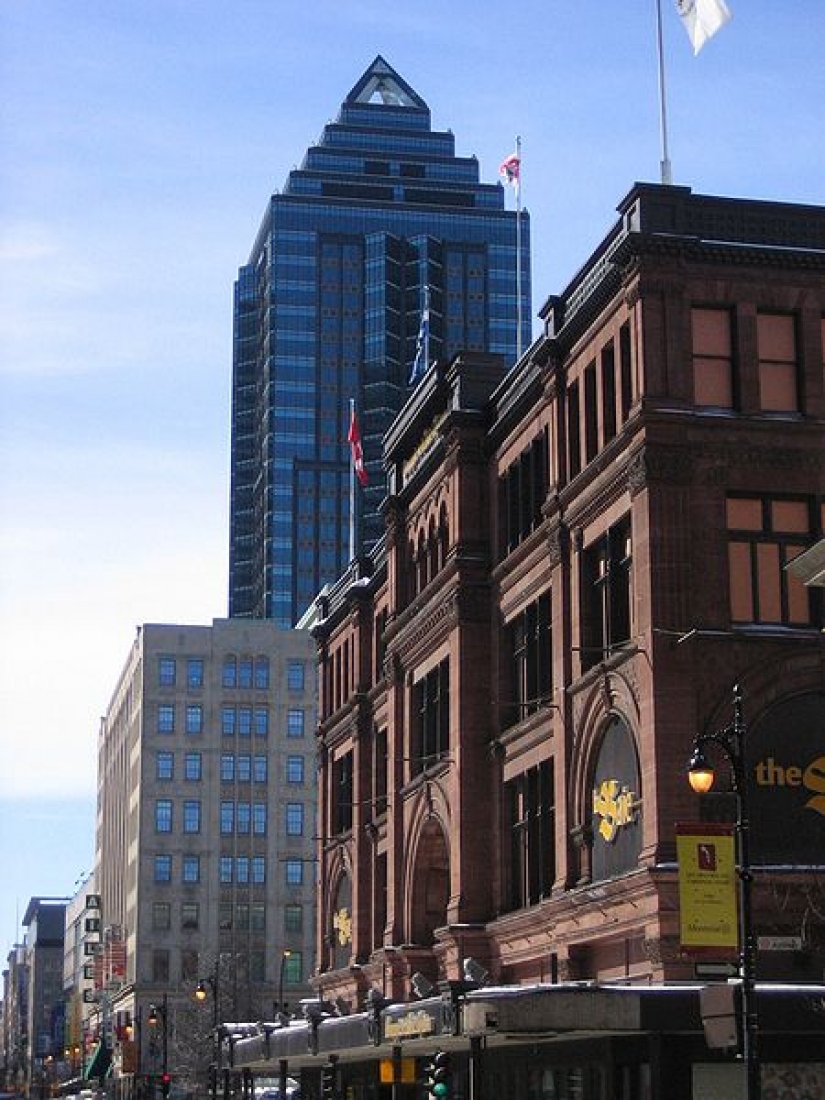 Montréal - The Bay on Saint-Catherine Street
Architecture is a regulated profession in Canada, and the route to it runs through a professional degree, an internship and a licensing exam. According to the Royal Architectural Institute of Canada (RAIC), the vast majority of Canadian architects hold a degree from a university programme accredited by the Canadian Architectural Certification Board (CACB). For an international student, the first question is therefore whether a programme is CACB-accredited.
SpainExchange lists 6 universities in Canada for architecture, one each in Vancouver, Calgary, Winnipeg, Toronto, Ottawa and Montreal.
How the degree is organised
The CACB recognises two types of accredited degree, the Master of Architecture (M.Arch) and the Bachelor of Architecture (B.Arch). In practice, the RAIC notes, the professional degree is now granted at master's level. University professional programmes last from five to seven years in total, according to the RAIC.
The usual structure has two steps:
- A pre-professional bachelor's degree in architecture, architectural studies or environmental design. This degree alone is not an accredited degree. McGill University, for example, describes its B.Sc.(Arch.) as a non-professional degree that must be followed by the M.Arch.
- A professional Master of Architecture of two years for students with a pre-professional degree, or about three years for graduates of other subjects.
The schools in the directory show the variations:
- At the University of British Columbia (UBC) the M.Arch takes three years and 117 credits. Holders of certain architecture bachelor's degrees receive 36 credits of advanced placement and finish in two years.
- At McGill University the professional M.Arch is a 60-credit programme of four terms over two academic years, and requires the equivalent of the B.Sc.(Arch.).
- The University of Calgary offers a three-year route open to applicants from any undergraduate discipline, which starts with a foundation year, and a two-year route. Its School of Architecture, Planning and Landscape states that it is Alberta's only accredited school of architecture.
- At the University of Manitoba the M.Arch is a two-year programme with coursework and a design thesis. The CACB granted it a six-year accreditation term in 2025.
The University of Toronto and Carleton University in Ottawa also appear on the RAIC list of Canadian schools of architecture. The universities named here teach in English. Quebec also has French-language schools of architecture, at the Université de Montréal and Université Laval.
Admission and language
Each school sets its own requirements, and admission is competitive. Typical elements of an M.Arch application are:
- a completed bachelor's degree, with official transcripts; the University of Manitoba asks for a four- or five-year degree in architecture or a related design field with a minimum GPA of 3.0 in the last two years
- a digital portfolio; UBC accepts a PDF of at most 20 pages
- a statement of intent and letters of recommendation
- proof of English proficiency where required
Programmes start in September. UBC accepts applications between 1 October and 15 January each year, and the University of Manitoba lists 15 January as its deadline for September entry.
Study permit and costs
Most foreign nationals need a study permit, which costs CAN$150 according to Immigration, Refugees and Citizenship Canada (IRCC). The application requires a letter of acceptance, in most cases a provincial or territorial attestation letter obtained through the university, and proof of funds. For applications from 1 September 2026, a single student outside Quebec must show CAN$23,448 for one year of living expenses, in addition to tuition and travel. Eligible students may work off campus up to 24 hours per week during term.
Tuition fees for international students are set by each university and differ by programme. UBC, for example, notes that its fees are reviewed every year. Applicants should use the fee calendar of the university for the year of entry.
Recognition and licensing
A degree is the first of three steps. Each province has its own regulatory body for the profession. After graduation, candidates enrol in the Internship in Architecture Program, which requires a minimum of 5,600 hours of work experience and usually takes about three years. They also sit the Examination for Architects in Canada (ExAC), which has four sections. Provincial associations also recognise the Architect Registration Examination (ARE) used in the United States.
According to UBC, CACB-certified degrees are recognised by the other signatories of the Canberra Accord: Australia, China, Korea, Mexico, the United Kingdom and the United States. Students who plan to work in another country should check its rules with the regulator there.
Architects who qualified outside Canada follow a different route. McGill advises them to contact the CACB, and the Broadly Experienced Foreign Architect (BEFA) Program assesses experienced foreign architects against Canadian standards.
Careers
Graduates of a professional programme usually start as intern architects in a practice while they complete their hours and exams. No official employment figures for architecture graduates were used for this page.
Frequently asked questions
How long does it take to become an architect in Canada?
University professional programmes last five to seven years in total, according to the RAIC. The internship that follows requires at least 5,600 hours and usually takes about three years.
Can I enter a Master of Architecture without an architecture degree?
At some schools, yes. The three-year M.Arch routes at UBC and the University of Calgary are open to graduates of other subjects. Two-year routes require a pre-professional architecture degree.
Is a Canadian architecture degree recognised abroad?
According to UBC, CACB-certified degrees are recognised by the other Canberra Accord signatories: Australia, China, Korea, Mexico, the United Kingdom and the United States. Licensing rules remain national.
Is a bachelor's degree in architecture enough to practise?
Not a pre-professional one. A pre-professional bachelor's degree is not an accredited degree on its own; it must be followed by a professional M.Arch.