Aerospace Engineering Schools and Programs in Australia
1 school in Australia teaches Aerospace Engineering.
University of New South Wales (UNSW)
University Sydney, Australia In an official register
UNSW Sydney (University of New South Wales) is a university in Sydney, Australia, founded in 1949. Its main campus is in Kensington; it also has the School of Art & Design campus in Paddington and UNSW Canberra at the Australian Defence Force Academy, as well as sites in…
Aerospace Engineering Studies in Australia
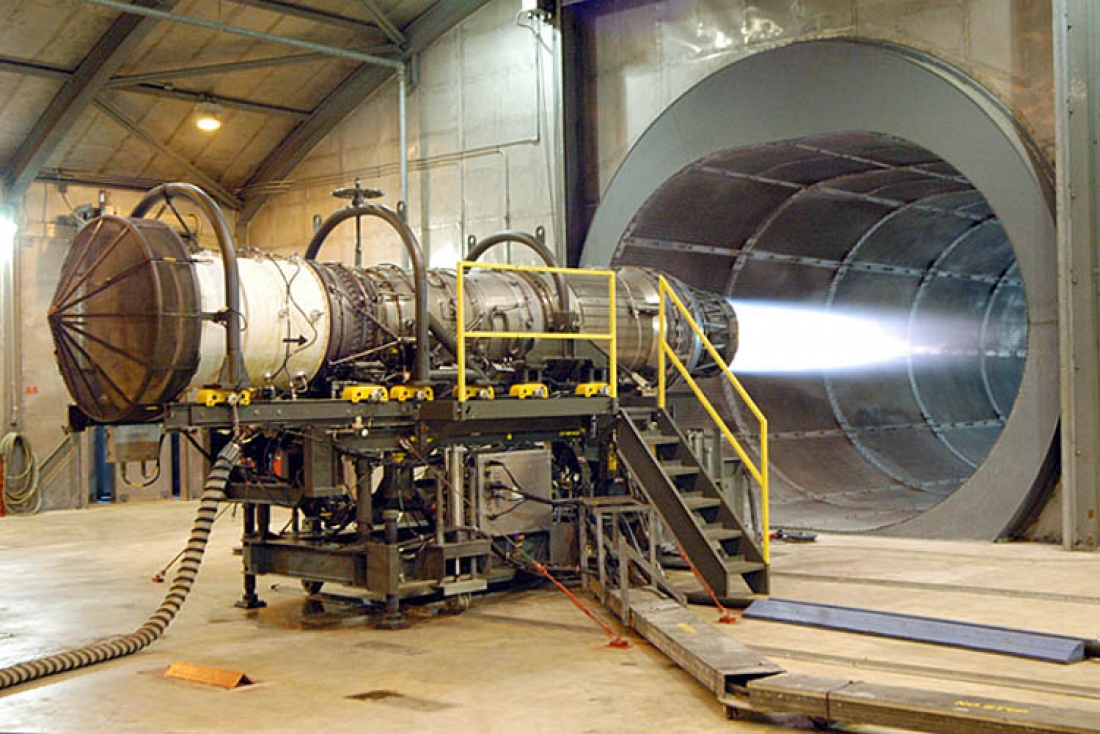 A jet engine being tested
Aerospace engineering deals with the design, manufacture and operation of aircraft, spacecraft and their systems. Students learn aerodynamics, flight mechanics, propulsion, structures and materials, and apply them in design projects. In Australia the subject is usually taught as a specialisation of a four-year Bachelor of Engineering (Honours), with space systems increasingly offered at master's level. Teaching is in English.
SpainExchange lists one school in Australia for aerospace engineering: the University of New South Wales (UNSW Sydney), whose engineering faculty is on the Kensington campus in Sydney.
How aerospace engineering degrees are organised
Australian qualifications sit within the Australian Qualifications Framework (AQF), which has 10 levels. According to Study Australia, the government's official study portal, a bachelor's degree typically takes 3 years, or 4 years for a bachelor honours degree; a doctorate takes 3 years. Professional engineering degrees are of the honours type, so a full undergraduate aerospace degree takes four years.
At UNSW the subject is split between two schools. The School of Mechanical & Manufacturing Engineering teaches the undergraduate aerospace degree, focused on aircraft and spacecraft design, aerodynamics, propulsion, structures and manufacturing. The School of Electrical Engineering & Telecommunications teaches a postgraduate programme in space systems.
- Bachelor of Engineering (Honours) (Aerospace Engineering): 4 years, 192 units of credit, intakes in terms 1, 2 and 3
- Double degrees combining aerospace engineering with commerce, science, arts or computer science
- Master of Engineering Science (Space Systems Engineering): 2 years, 96 units of credit, for graduates in engineering
The bachelor's degree ends with a team project in which students design a complete aircraft for a defined mission, and it includes 60 days of approved industry training. Facilities include an aerodynamics laboratory with four wind tunnels. UNSW is moving to a new Flex-Semester academic calendar from 2028, so the length of a degree can vary for students who start before then.
Admission and language
Undergraduate courses require an Australian Year 12 certificate or an equivalent. For 2026 entry to the aerospace degree, UNSW gives a lowest selection rank of 95.0, an IB Diploma score of 39.0 and an A-level score of 16.0, with mathematics (Extension 1 level) and physics as assumed knowledge. Students who do not meet direct entry can take a foundation course, usually one year long, or a 12-month UNSW College diploma that mirrors the first year of the degree. Students whose first language is not English must prove their English level before they receive an offer.
The space systems master's requires a four-year engineering degree or a three-year engineering science degree, with an average of at least 65%. UNSW describes it as a non-accredited programme: it deepens expertise but is not itself a professional engineering qualification. UNSW notes that some programmes were full for 2026 intakes for new international students, while applications to all 2027 intakes are open.
Costs and visa
Tuition fees for international students vary by provider, level and location. For international students starting in 2026, UNSW lists an indicative first-year fee of $61,500 and $265,500 to complete the aerospace bachelor's degree, and $61,000 for the first year and $127,000 in total for the space systems master's. International students need a Student visa (subclass 500); from 1 July 2026 the application fee is from AUD$2,500. Visa holders may work up to 48 hours per fortnight while their course is in session and must keep health insurance for their whole stay.
Recognition and careers
The UNSW aerospace specialisation is fully accredited by Engineers Australia at the level of Professional Engineer, and its graduates are recognised internationally through the Washington Accord. According to UNSW, aerospace graduates work in design offices, in the manufacture, testing and repair of aircraft, in regulatory and certification authorities, in defence organisations, in research and in software companies. Graduates with a bachelor's, master's or doctoral degree may be eligible for the Temporary Graduate visa (subclass 485) to work in Australia after their studies.
Frequently asked questions
How long does an aerospace engineering degree take in Australia?
The UNSW Bachelor of Engineering (Honours) (Aerospace Engineering) takes four years of full-time study. A master's in space systems engineering adds two years.
Is an Australian aerospace engineering degree recognised abroad?
The UNSW aerospace specialisation is accredited by Engineers Australia, and its graduates are recognised internationally through the Washington Accord.
Can I start a master's in space engineering without an aerospace degree?
Yes, if you have an engineering degree. UNSW admits graduates of related disciplines directly and graduates of other engineering fields through a graduate certificate pathway, with an average of at least 65% in both cases.
Do aerospace students get industry experience?
Yes. The UNSW bachelor's degree requires 60 days of approved industry training before graduation.